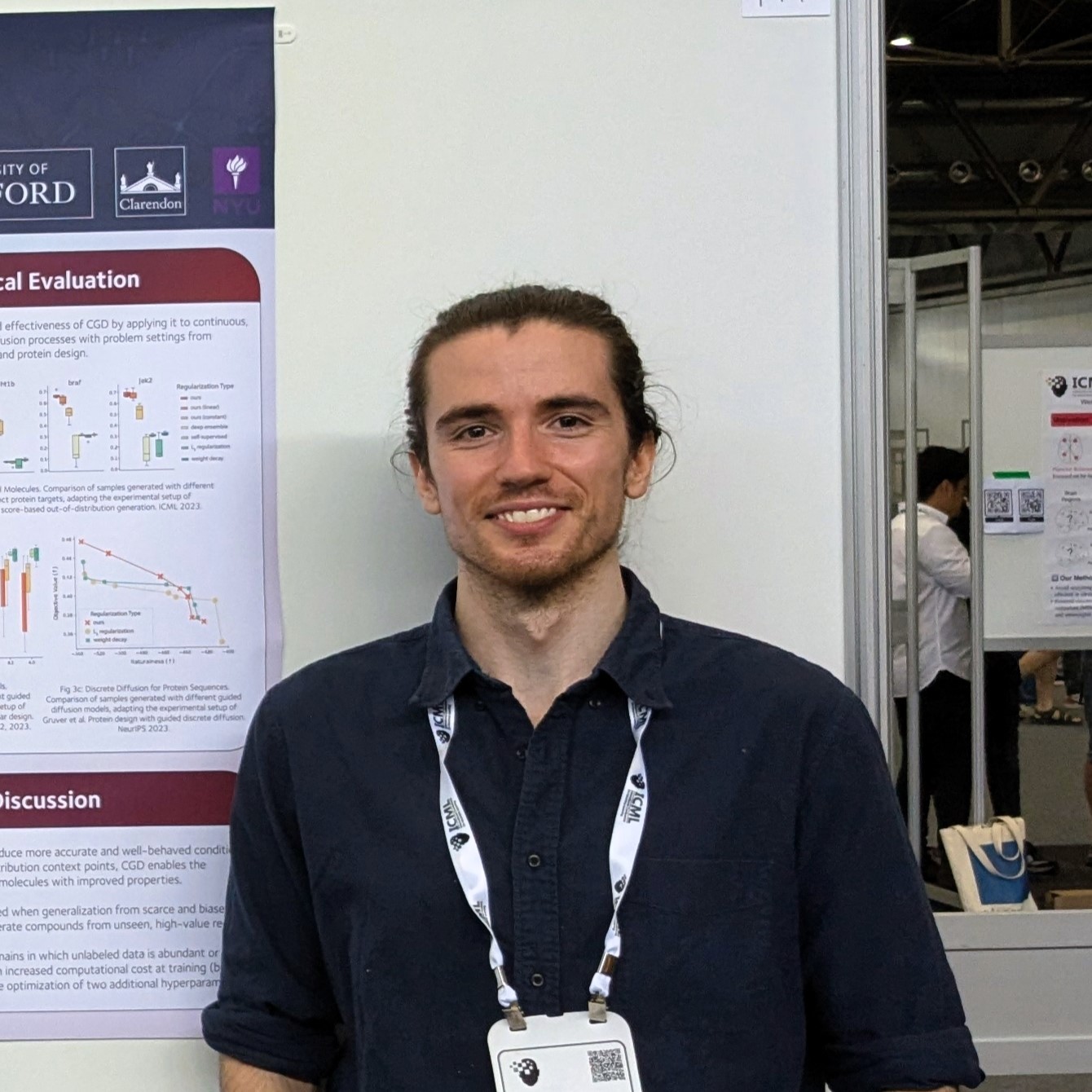
I’m an ML Research Scientist at Isomorphic Labs, where I work on generative AI for drug discovery.
Before joining Iso, I completed my PhD in the Oxford CompStats & Machine Learning (OxCSML) and Protein Informatics (OPIG) groups. My research focused on developing more robust and data-efficient generative models for early-stage drug discovery and protein design, supervised by Profs Yee Whye Teh, Charlotte Deane and Garrett Morris. My work was funded by Oxford’s flagship academic merit scholarship.
During my PhD I interned in the AI team at VantAI in New York and the Data Science and Analytics team at Roche in Basel.
Prior to Oxford, I studied Interdisciplinary Sciences (chemistry, biology, and CS) at ETH Zürich. During this time I designed antimicrobial peptides with Prof Gisbert Schneider and engineered bacteria for targeted cancer therapy with Prof Simone Schürle-Finke.
Publications
2024
Context-Guided Diffusion for Out-of-Distribution Molecular and Protein Design
Leo Klarner, Tim G. J. Rudner, Garrett M Morris, Charlotte Deane, and Yee Whye Teh
International Conference on Machine Learning(ICML), 2024
Generative models have the potential to accelerate key steps in the discovery of novel molecular therapeutics and materials. Diffusion models have recently emerged as a powerful approach, excelling at unconditional sample generation and, with data-driven guidance, conditional generation within their training domain. Reliably sampling from high-value regions beyond the training data, however, remains an open challenge – with current methods predominantly focusing on modifying the diffusion process itself. In this paper, we develop context-guided diffusion (CGD), a simple plug-and-play method that leverages unlabeled data and smoothness constraints to improve the out-of-distribution generalization of guided diffusion models. We demonstrate that this approach leads to substantial performance gains across various settings, including continuous, discrete, and graph-structured diffusion processes with applications across drug discovery, materials science, and protein design.
@inproceedings{klarner2024contextguided,title={Context-Guided Diffusion for Out-of-Distribution Molecular and Protein Design},author={Klarner, Leo and Rudner, Tim G. J. and Morris, Garrett M and Deane, Charlotte and Teh, Yee Whye},author_show={Leo Klarner and Tim G. J. Rudner and Garrett M Morris and Charlotte Deane and Yee Whye Teh},booktitle={Proceedings of the 41st International Conference on Machine Learning},booktitle_show={International Conference on Machine Learning},booktitle_abbr={ICML},year={2024},series={Proceedings of Machine Learning Research},publisher={PMLR},url={https://arxiv.org/abs/2407.11942},pdf={https://arxiv.org/pdf/2407.11942},bibtex_show={true},selected={true}}
2023
Metropolis Sampling for Constrained Diffusion Models
Nic Fishman, Leo Klarner, Emile Mathieu, Michael Hutchinson, and Valentin De Bortoli
Advances in Neural Information Processing Systems(NeurIPS), 2023
Denoising diffusion models have recently emerged as the predominant paradigm for generative modelling on image domains. In addition, their extension to Riemannian manifolds has facilitated a range of applications across the natural sciences. While many of these problems stand to benefit from the ability to specify arbitrary, domain-informed constraints, this setting is not covered by the existing (Riemannian) diffusion model methodology. Recent work has attempted to address this issue by constructing novel noising processes based on the reflected Brownian motion and logarithmic barrier methods. However, the associated samplers are either computationally burdensome or only apply to convex subsets of Euclidean space. In this paper, we introduce an alternative, simple noising scheme based on Metropolis sampling that affords substantial gains in computational efficiency and empirical performance compared to the earlier samplers. Of independent interest, we prove that this new process corresponds to a valid discretisation of the reflected Brownian motion. We demonstrate the scalability and flexibility of our approach on a range of problem settings with convex and non-convex constraints, including applications from geospatial modelling, robotics and protein design.
@inproceedings{fishman2023metropolis,title={Metropolis Sampling for Constrained Diffusion Models},author={Fishman, Nic and Klarner, Leo and Mathieu, Emile and Hutchinson, Michael and Bortoli, Valentin De},author_show={Nic Fishman and Leo Klarner and Emile Mathieu and Michael Hutchinson and Valentin De Bortoli},booktitle={Advances in Neural Information Processing Systems 37},booktitle_show={Advances in Neural Information Processing Systems},booktitle_abbr={NeurIPS},year={2023},url={https://openreview.net/pdf?id=jzseUq55eP},pdf={https://openreview.net/pdf?id=jzseUq55eP},bibtex_show={true},selected={true}}
GAUCHE: A Library for Gaussian Processes in Chemistry
Ryan-Rhys Griffiths, Leo Klarner, Henry Moss, Aditya Ravuri, Sang T. Truong, Yuanqi Du, Samuel Don Stanton, Gary Tom, Bojana Ranković, Arian Rokkum Jamasb ... Alpha Lee, Bingqing Cheng, Alan Aspuru-Guzik, Philippe Schwaller, and Jian Tang
Advances in Neural Information Processing Systems(NeurIPS), 2023
We introduce GAUCHE, an open-source library for GAUssian processes in CHEmistry. Gaussian processes have long been a cornerstone of probabilistic machine learning, affording particular advantages for uncertainty quantification and Bayesian optimisation. Extending Gaussian processes to molecular representations, however, necessitates kernels defined over structured inputs such as graphs, strings and bit vectors. By providing such kernels in a modular, robust and easy-to-use framework, we seek to enable expert chemists and materials scientists to make use of state-of-the-art black-box optimization techniques. Motivated by scenarios frequently encountered in practice, we showcase applications for GAUCHE in molecular discovery, chemical reaction optimisation and protein design. The codebase is made available at https://github.com/leojklarner/gauche.
@inproceedings{griffiths2023gauche,title={{GAUCHE}: A Library for Gaussian Processes in Chemistry},author={Griffiths, Ryan-Rhys and Klarner, Leo and Moss, Henry and Ravuri, Aditya and Truong, Sang T. and Du, Yuanqi and Stanton, Samuel Don and Tom, Gary and Rankovi{\'c}, Bojana and Lee, Arian Rokkum Jamasb ... Alpha and Cheng, Bingqing and Aspuru-Guzik, Alan and Schwaller, Philippe and Tang, Jian},author_show={Ryan-Rhys Griffiths and Leo Klarner and Henry Moss and Aditya Ravuri and Sang T. Truong and Yuanqi Du and Samuel Don Stanton and Gary Tom and Bojana Rankovi{\'c} and Arian Rokkum Jamasb ... Alpha Lee and Bingqing Cheng and Alan Aspuru-Guzik and Philippe Schwaller and Jian Tang},booktitle={Advances in Neural Information Processing Systems 37},booktitle_show={Advances in Neural Information Processing Systems},booktitle_abbr={NeurIPS},year={2023},url={https://openreview.net/pdf?id=vzrA6uqOis},pdf={https://openreview.net/pdf?id=vzrA6uqOis},code={https://github.com/leojklarner/gauche},bibtex_show={true},selected={true}}
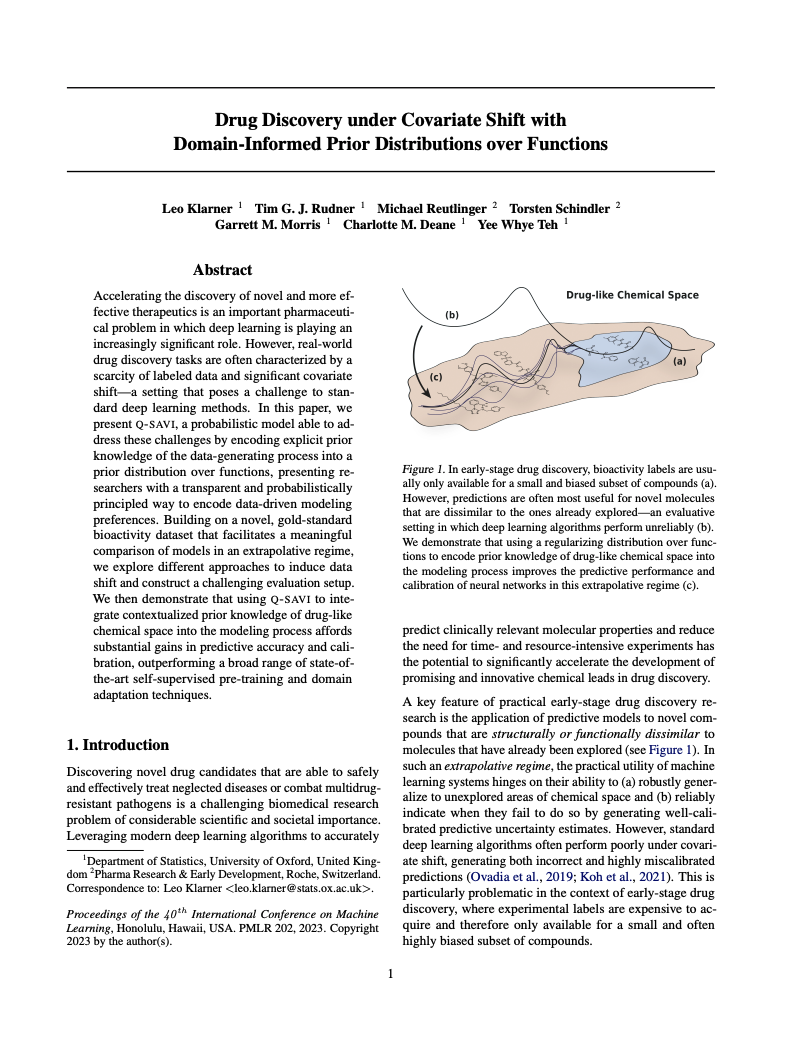
Drug Discovery under Covariate Shift with Domain-Informed Prior Distributions over Functions
Leo Klarner, Tim G. J. Rudner, Michael Reutlinger, Torsten Schindler, Garrett M. Morris, Charlotte Deane, and Yee Whye Teh
International Conference on Machine Learning(ICML), 2023
Accelerating the discovery of novel and more effective therapeutics is an important pharmaceutical problem in which deep learning is playing an increasingly significant role. However, real-world drug discovery tasks are often characterized by a scarcity of labeled data and significant covariate shift—a setting that poses a challenge to standard deep learning methods. In this paper, we present Q-SAVI, a probabilistic model able to address these challenges by encoding explicit prior knowledge of the data-generating process into a prior distribution over functions, presenting researchers with a transparent and probabilistically principled way to encode data-driven modeling preferences. Building on a novel, gold-standard bioactivity dataset that facilitates a meaningful comparison of models in an extrapolative regime, we explore different approaches to induce data shift and construct a challenging evaluation setup. We then demonstrate that using Q-SAVI to integrate contextualized prior knowledge of drug-like chemical space into the modeling process affords substantial gains in predictive accuracy and calibration, outperforming a broad range of state-of-the-art self-supervised pre-training and domain adaptation techniques.
@inproceedings{klarner2023qsavi,title={{D}rug {D}iscovery {u}nder {C}ovariate {S}hift {w}ith {D}omain-{I}nformed {P}rior {D}istributions {o}ver {F}unctions},author={Klarner, Leo and Rudner, Tim G. J. and Reutlinger, Michael and Schindler, Torsten and Morris, Garrett M. and Deane, Charlotte and Teh, Yee Whye},author_show={Leo Klarner and Tim G. J. Rudner and Michael Reutlinger and Torsten Schindler and Garrett M. Morris and Charlotte Deane and Yee Whye Teh},booktitle={Proceedings of the 40th International Conference on Machine Learning},booktitle_show={International Conference on Machine Learning},booktitle_abbr={ICML},year={2023},series={Proceedings of Machine Learning Research},publisher={PMLR},url={https://proceedings.mlr.press/v202/klarner23a.html},pdf={https://proceedings.mlr.press/v202/klarner23a.html},bibtex_show={true},preview={klarner2023qsavi.png},code={https://github.com/leojklarner/Q-SAVI},selected={true}}
Diffusion Models for Constrained Domains
Nic Fishman, Leo Klarner, Valentin De Bortoli, Emile Mathieu, and Michael Hutchinson
Transactions on Machine Learning Research(TMLR), 2023
Denoising diffusion models are a novel class of generative algorithms that achieve state-of-the-art performance across a range of domains, including image generation and text-to-image tasks. Building on this success, diffusion models have recently been extended to the Riemannian manifold setting, broadening their applicability to a range of problems from the natural and engineering sciences. However, these Riemannian diffusion models are built on the assumption that their forward and backward processes are well-defined for all times, preventing them from being applied to an important set of tasks that consider manifolds defined via a set of inequality constraints. In this work, we introduce a principled framework to bridge this gap. We present two distinct noising processes based on (i) the logarithmic barrier metric and (ii) the reflected Brownian motion induced by the constraints. As existing diffusion model techniques cannot be applied in this setting, we proceed to derive new tools to define such models in our framework. We then empirically demonstrate the scalability and flexibility of our methods on a number of synthetic and real-world tasks, including applications from robotics and protein design.
@inproceedings{fishman2023diffusion,title={Diffusion Models for Constrained Domains},author={Fishman, Nic and Klarner, Leo and Bortoli, Valentin De and Mathieu, Emile and Hutchinson, Michael},author_show={Nic Fishman and Leo Klarner and Valentin De Bortoli and Emile Mathieu and Michael Hutchinson},booktitle={Transactions on Machine Learning Research},booktitle_show={Transactions on Machine Learning Research},booktitle_abbr={TMLR},year={2023},series={Proceedings of Machine Learning Research},publisher={PMLR},url={https://openreview.net/pdf?id=xuWTFQ4VGO},pdf={https://openreview.net/pdf?id=xuWTFQ4VGO},bibtex_show={true},selected={true}}
2022
Bias in the Benchmark: Systematic experimental errors in bioactivity databases confound multi-task and meta-learning algorithms
Leo Klarner, Michael Reutlinger, Torsten Schindler, Charlotte Deane, and Garrett Morris
2nd ICML AI for Science Workshop, 2022
Best Poster Award at 5th AI for Chemistry Conference, 2022
There is considerable interest in employing deep learning algorithms to predict pharmaceutically relevant properties of small molecules. To overcome the issues inherent in this low-data regime, researchers are increasingly exploring multi-task and meta-learning algorithms that leverage sets of related biochemical and toxicological assays to learn robust and generalisable representations. However, we show that the data from which commonly used multi-task benchmarks are derived often exhibits systematic experimental errors that lead to confounding statistical dependencies across tasks. Representation learning models that aim to acquire an inductive bias in this domain risk compounding these biases and may overfit to patterns that are counterproductive to many downstream applications of interest. We investigate to what extent these issues are reflected in the molecular embeddings learned by multi-task graph neural networks and discuss methods to address this pathology.
@inproceedings{klarner2022bias,title={Bias in the Benchmark: Systematic experimental errors in bioactivity databases confound<br>multi-task and meta-learning algorithms},author={Klarner, Leo and Reutlinger, Michael and Schindler, Torsten and Deane, Charlotte and Morris, Garrett},author_show={Leo Klarner and Michael Reutlinger and Torsten Schindler and Charlotte Deane and Garrett Morris},url={https://openreview.net/pdf?id=Gc5oq8sr6A3},pdf={https://openreview.net/pdf?id=Gc5oq8sr6A3},booktitle_show={2nd ICML AI for Science Workshop},year={2022},bibtex_show={true},selected={true},note={Best Poster Award at 5th AI for Chemistry Conference, 2022}}